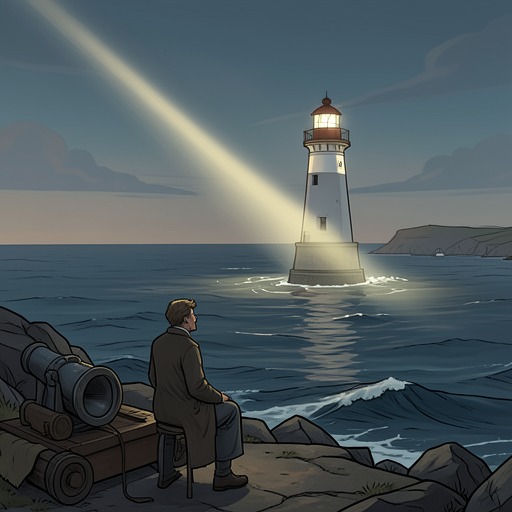
“the long steady stroke”
To the Lighthouse“the long steady stroke” names the Lighthouse beam that Mrs Ramsay watches during an evening alone with her knitting. She calls it “her stroke,” making the distant, impersonal light at once a feature of the landscape and a private point of attachment. Its steady return accompanies her movement from solitude into self-scrutiny and, briefly, into happiness.
A Light Claimed in Solitude
As the evening stills around her, Mrs Ramsay pauses over a long reddish-brown stocking and looks toward the Lighthouse. She has been thinking of the self beneath the roles and appearances by which other people know her, and of the freedom that comes when those familiar attachments fall away. In that inward quiet, she repeatedly watches the beam until she feels herself becoming what she sees. The long stroke is “her stroke”: not because it belongs to her, but because, in this moment, she singles it out and invests it with a personal relation.
The light also gives shape to a thought she cannot quite settle. While watching it, Mrs Ramsay recalls the phrase “Children don’t forget” and repeats it, then moves through the expectation that things will end and come. She suddenly says, “We are in the hands of the Lord,” but immediately feels that the statement is not true to her. The next stroke seems to meet her gaze like her own eyes, searching her mind and heart and exposing the words as a lie. The beam’s recurring presence thus becomes an occasion not for religious reassurance but for a sterner encounter with what she actually believes.
The Beam and the Limits of Consolation
Mrs Ramsay’s inward response to the light is not simple comfort. She knows that the world contains suffering, death, and poverty, and that happiness does not last; no providential order, in her understanding, makes those facts just. The beam remains steady while her thought rejects the consoling claim she has just uttered. Its constancy does not prove that the world is benevolent. Instead, its measured passage gives her a focus from which to examine the difference between a phrase that offers comfort and a truth she can accept.
At the same time, the light draws tenderness from her. Alone, she feels that trees, streams, flowers, and other inanimate things can express or become something of oneself. The Lighthouse beam is both “so much her” and “so little her”: it answers her attention without being reducible to her, and its remoteness intensifies rather than erases that separation. As daylight fades, the beam silvering the rough waves accompanies an ecstatic recognition that she has known happiness, intense and exquisite. Her response culminates in the words “It is enough! It is enough!”—a temporary fullness, not a claim that suffering or loss has disappeared.
Repetition, Distance, and Narrative Significance
The beam’s repeated stroke organizes the scene through return and contrast. Mrs Ramsay watches, attaches herself to one feature of what she sees, and allows it to carry a phrase rising from her mind; then the light’s next appearance tests the thought she has formed. Her description moves between distance and intimacy, steadiness and change: the light is pitiless and remorseless, yet capable of being felt as her own; she is separated from others, yet reaches a moment of peace through attending to something outside herself. The recurring image gives these shifts a visible rhythm without resolving their contradictions.
That separation remains present even as happiness comes. Mrs Ramsay’s husband sees her alone and beautiful, wants to speak, but chooses not to interrupt her. He senses her remoteness and feels unable to protect or help her. The light, then, marks a private experience that another person can witness but cannot simply enter. Its significance lies in holding together solitude, self-recognition, and a brief experience of enoughness: the beam offers no final answer to Mrs Ramsay’s knowledge of pain, but its steady passage accompanies a moment that is fully real without promising permanence.